
Open post

Watch List Building For Beginners

Building a watch list of tickers that fall within your trading strategy is an essential part of profitable trading. There are roughly over 15,000 stocks that trade on the US markets alone; far too many for you to be able to filter through each and every one. Attempting to do this would leave absolutely zero time for actual trading!

Thankfully the modern trader is spoiled with an abundance of stock scanners and screeners they can use which will help filter out the noise and find strong stocks.

Your daily watch list ideally starts out rather large in premarket, and then throughout the trading day it should evolve and wind down to only 2 or 3 stocks to focus on.

Step 1: Know Your Strategy

The first step in your watch list generation is to really understand what type of stocks you are looking for. Now, there really is no right or wrong answer for this; It really boils down to what strategy you trade. If you trade multiple strategies, its generally best to have separate scanners for each. This will keep things neat and simple to follow.

Do you primarily trade big chip stocks? Then your scanner settings would likely only include stocks over $10 per share. Only small caps? Then  your scanner settings should ignore all stocks over $10 per share. You can scan for hundreds of parameters like Float, Dollar volume, Percent Change to identify exactly what you are looking for.

Think about your strategy and what common parameters any stock would need to fit in order to fall within it. For example, let’s say that your strategy is to dip buy stocks that are extremely sold off. You have a particular interest in low float stocks breaking new 52 week lows, so you can use that to your advantage:

  • Strategy: Dip Buy All Time Lows with Volume
  • Trigger: Breaking 52 week lows
  • Float: Less than 25 million shares
  • Volume: Greater than 100,000

A scanner that had these parameters would immediately filter out thousands of stocks that do not fit your criteria.

This immediately prevents you from overtrading or trading stocks that are out of your criteria, which will immediately increase your profitability. It will also transform your process into a more process-orientated one, one which you can build a daily routine around.

Step 2: Using Scanners To Develop The Watch List

It’s important to note that not ALL stocks on your scanners will become trade setups.. they are just stocks with potential trades. It’s very important to further verify that the stock can become a

The scanner that I use daily is Scanz, read more about it here

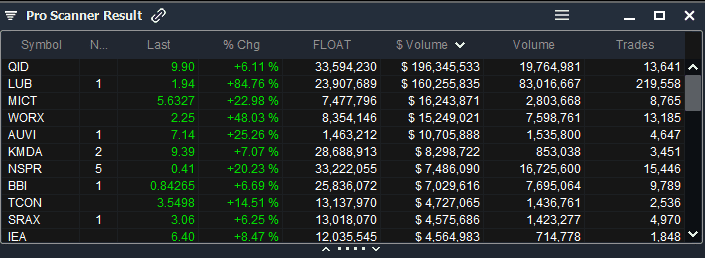
Here is a breakdown of one of the main scanners that I use within Scanz:

  • Price : Between $0.10 and $10.00
  • Percent Change: +5%
  • Day’s Trades: 250
  • Float: < 35 million shares

This will essentially find any Small Cap Stock that is green on the day with some sort of catalyst. The percent change ensures its green on the day, and having more than 250 trades hints that it is somewhat liquid. Obviously, most of the stocks I trade have thousands of trades, but I don’t want to cast my net too small early in the day.Sign up for Scanz 14 Day Trial
If you don’t have Scanz or can’t afford it in your current trading budget, that’s totally fine. Most brokers nowadays like ThinkOrSwim and WeBull have built-in scanners that work pretty well. You can also find a free scanner on Finviz, although that one is very lacking in its features.

Depending on your strategy, you’ll want to either scan for stocks after market close, or before market open. I Start my morning at about 4:00am (7:00am EST) and have my scanners run continuously throughout the day.

This allows me to see stocks as they cross my scanner parameters, allowing me sufficient time to run the stock through the TradeBuddy Trading Checklist and plan a trade before it’s too late.

Having real-time scanners can give you a massive edge, whereas a scanner like Finviz only updates every time you refresh the page.

Step 3: Creating Your Watch List

This is where you decide whether or not any particular stock that shows up on your scanner is actually worthy of your attention.

Remember, a stock simply showing up on your scanner does NOT mean its time to buy. I purposefully cast my scanners ‘net’ very wide so that I can see a broad range of stocks; I understand that a ton of them simply wont be worthwhile. It only takes a few seconds for me to view the daily chart and the catalyst and come up with a decision to trade or not.

For my strategy, I simply look at each stock that has a news catalyst. In the above picture example, the stocks that I would look at first are LUB, AUVI, KMDA, NSPR, BBI, and SRAX.
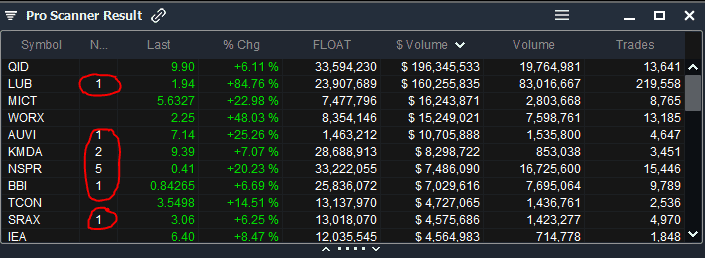
The numbers next to the symbol represent amount of news releases today

By clicking on the # of news releases I can quickly view the news causing the stock to run. Then, if I am a fan of the news I will pull up the ticker and look at the Daily time frame. I then determine whether or not it fits my ‘A+ Setup’ and go from there. You can learn more about this strategy by signing up for the free trading workshop

From here, you would have ideally created a Trading Plan. This means you identified levels where you want to enter the stock, levels that you want to lock in profits, and the level that you will stop out for a loss at.

Having the trading plan ready BEFORE you take the trade is an absolutely integral part of trading.

Once you’ve analyzed each chart with news, you can decide whether or not you want to look at other stocks, depending on if you have enough plays for the day. This is where trader intuition and experience can really save you time; You’ll start to naturally figure out what stocks will not be in play based on their share structure, volume, and catalyst.

Step 4: Maintaining your Watch List

Once you reach this part in your daily routine, it should be very clear which stocks are in play based on your trading strategy. Now, your job is to simply have all of these stocks on your watch list, as long as their potential remains true.

Has a stock completed its move? Did it fail to do what you expected? It is your job to maintain the watch list appropriately. A watch list is only as good as the trader that maintains it!

At the end of the day, review your watch list again. If there are any stocks that are lasting on your watch list, you can choose to either move them to your long-term watchlist or have them ready on the following day’s watch.

Always make sure that your watch list is never too cluttered, and always take time to review the stocks on your list in order to ensure that they deserve your attention

Final Thoughts

Having a watch list is very important for any trader, day trader and swing traders alike. Using modern scanning tools allows you to focus on the stocks that truly matter.

With every trading process, its important that you follow a consistent routine to eliminate any possibility of variables ruining your edge. My watch list development follows a strict morning routine that I repeat day after day, and I recommend that you do something similar.

Be sure that you know what your trading strategy is and what you are looking for; from there its simply a matter of learning how to use the scanners to find what you need.

Need help finding your strategy, or simply want to copy our watch lists? Join TradeBuddy today via our 14 Day Trial

Open post

OTC Markets Group Inc. – Day Traders’ Dictionary

The OTC Markets Group is the owner and operator of the most substantial U.S. inter-dealer electronic quotation and trading system for over-the-counter (OTC) securities. It provides marketplaces for trading 10,000 OTC securities, making it the third-largest U.S. equity trading forum.

The OTC Markets Group breaks their financial markets down into three tiers, distinguishing companies based on the quality and quantity of the companies’ disclosure and financial information. this division provides different levels of transparency and risk for investors.


OTC Markets Tier Structure

OTCQX: is the top tier of the three marketplaces for the OTC. Stocks that trade on this exchange must meet very strict qualification criteria compared to the other levels. This market includes a large number of blue chips stocks from Europe, Canada, Brazil, and Russia. These large foreign stocks are frequently global household names. Penny stocks, shell companies, and companies in bankruptcy cannot qualify for a listing on the OTCQX.

OTCQB: also known as “The Venture Market,” this is the middle tier of the 3 marketplaces of the OTC. This exchange consists of early-stage and developing U.S. and international companies that are not yet able to qualify for the OTCQX. The company must be current in their reporting, undergo annual verification and certification, meet a $0.01 bid test, and may not be in bankruptcy to meet eligibility standards. Companies listed here report to a U.S. regulator such as the SEC or Federal Deposit Insurance Corporation. The OTCQB replaced the Financial Industry Regulatory Authority (FINRA)-operated OTC Bulletin Board (OTCBB) as the main market for trading OTC securities that report to a U.S. regulator. As it has no minimum financial standards, the OTCQB includes shell companies, penny stocks, and small foreign issuers.

OTC Pink: Also known as “Pink Sheets” is the lowest tier exchange that the OTC Markets Group offers. This marketplace offers to trade a wide range of equities through any broker and includes companies in bankruptcy, financial destress, default, or even non-existent companies whatsoever (shell companies). OTC Pink has no disclosure requirements, so the categorization of  these companies is based solely on info provided by them.

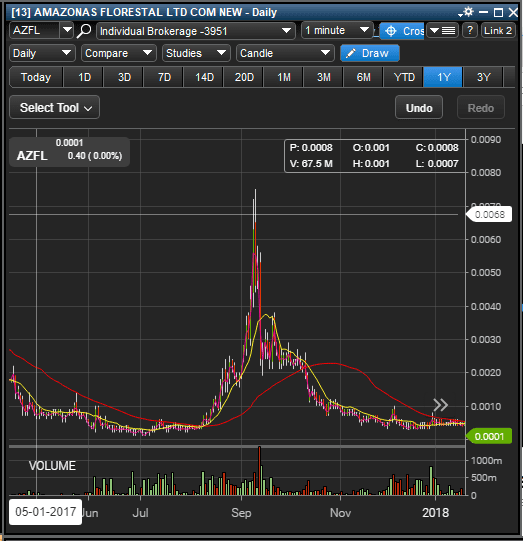
OTC stocks can be very lucrative if traded properly, based on the fact that they are so low priced. It is a lot easier for these types of stocks to spike significant percentages (50%, 100%, 500%) since they are a low lower priced and a lot less liquid. However, they can drop just as fast:

Here is $AZFL, an OTC Pink company that ran from around .0006 to just about .0077 in less than 2 months, leading to gains of over 1000%. When it lost momentum though, it dropped like a rock and presented no real exit opportunities for people who chased. Now it is sitting at .0001, meaning anyone who held the bag through this play has lost all of their money.


When trading OTC stocks, its very important to understand that they trade vastly different than NASDAQ listed or AMEX listed stocks, due to the fact that they do no have electronic automated market makers to facilitate transactions. OTC stocks are generally a lot less liquid, meaning that it can be very hard to exit your position without subjecting yourself to a lot of slippage.


99% of these companies will eventually fail, so never get ‘married to the news’ or hold on to a loss hoping for a bounce!

Want to learn more about trading stocks, and, more specifically, how to trade stocks the right way? Register now for our free masterclass that we are hosting this week: There are only a few seats left!

Day Trade – Day Trader’s Dictionary

Day Trade: To buy and sell a stock within the same day in order to capitalize on a stocks price movement.

So, for example, If I were to buy shares of Apple, Inc. ($AAPL) on Monday, I would have to sell it on the same day for it to be considered a day trade.

This little bit of information is important because US Citizens are subject to the Pattern Day Trader Rule. This rule restricts anyone who has less than a $25k Margin Account from placing more than 3 day trades within a rolling 5 day period. If you break this rule, you will be forced to swing trade ONLY until you deposit $25k into your trading account.


Want to know how to get around the PDT Rule? Click Here

Day traders usually fall into 2 categories: Long-biased traders and Short-biased traders. Most of us here at TradeBuddy are long biased traders, but we do have some amazing short biased traders. Its good to learn both types of trading so that you can use reverse psychology to find exactly where the ‘other side’ of the trade will act the most emotional.

There are a ton of different trading setups and strategies that people use to do this, but it’s important to understand that just because a setup works for someone else, does not mean that it will work for you. Traders are individuals who have different ways of thinking and perceiving information, which can greatly affect how you will trade compared to someone else.

Some strategies contain a ton of risk, while others have less perceived risk but require to you be lightning fast. Others can be slower trades altogether; there are a thousand different ways to make money in the market and your only job is to find a few ways to do it consistently. It takes time to develop your own setups that best fit your personality, which is why we highly recommend Paper Trading before risking your hard earned cash.

My Top Setups for Trading Breakouts

Every Trader is looking for their A+ setup – the one that’ll increase their odds and make it possible to win most of their trades. The reality is, there’s no perfect setup. Sometimes things simply go wrong and there’s nothing you can do about that.

But in an imperfect world, there are plenty of good trading setups and strategies that any trader can benefit from using.

Breakout Trading happens to be one of them. The cool part? There’s more than one way to play a breakout and different types of breakouts present different opportunities. If you want to learn my breakout trading strategies, get my Top 10 Trading Setups PDF. It’s the best cheat sheet you can get and its completely free.


What Is Breakout Trading?

Let’s first get to the basics and define Breakouts first. A Breakout is a price movement through a level of historical resistance. Don’t know what resistance is? Get into TradeBuddy University  today with a 14-day free trial.

In the chart above, you can see that Natural Shrimp Inc (OTC:SHMP) broke through resistance levels that developed as the stock’s price dropped over the course of several months.

Notice the volume candles at the bottom of the chart when the breakout happened; Volume and volatility will always occur at or near breakout levels.

Now, the obvious way to play this strategy is to buy (go long) on the breakout and then sell and take profits as the stock squeezes higher.

Benefits of Trading Breakouts

Like every single pattern that myself and my students use, there’s a statistical edge within our favor. It’s the probabilities of success stretched out over hundreds of trades that we care about; not individual wins or losses

Risk Management For Breakout Trading

As with every strategy that I teach, breakout trading should be clearly planned out. You should have an extremely clear understanding of exactly where you are going to enter the trade, where you will be taking profits if you are right, and where you will be cutting your loss (QUICKLY) if you are wrong.

Every day-trading strategy that I use includes risk management. It’s simply built into the strategy.

Risk management is an extremely important concept; it’s one of the 3 “Pillars of Trading” and you should spend a significant time learning the best risk management strategies and understanding it to its fullest.

Risk management can help you control losses and optimize your profit taking. The most important thing with risk management is a risk:reward ratio, which provides a way for you to determine if a potential trade is worth it or not.

My Favorite Breakout Trading Patterns

I detail my favorite Breakout Trading Patterns in this free PDF so I highly recommend that you get it! It only takes a few seconds to obtain and it will REALLY change the way you look at trading if you haven’t been exposed to topics like these before. Here’s a sneak peek of what you’ll get:

Master your Craft with TradeBuddy University

As you can see, you need to study up! Join TradeBuddy University today via a 14-day free trial if you’re serious about trading. You get access to my video lessons, live webinars, one of the best trading chat rooms around, 24/7 communication with our top mentors, breakdowns of my trades and in-depth analysis of the biggest runners in today’s market.

It’s an amazing program that can help you on your path to becoming a self-sufficient trader.

Conclusion

Breakout Trading is one of the most consistent ways that traders grow their small accounts. However, it is not a fool-proof system. You must make sure that you are trading the right types of breakouts and always follow a plan when doing so.

Are you a trader? What’s your experience with trading breakouts? Comment below and tell other traders about your best breakout trade and give tips on how to be successful doing so!

New to trading? Comment below saying “I will learn to trade breakouts!”